

This is Part 2 of a series. For my previous post on the history of Schrödinger puzzles and grid considerations, you can read Part 1 here. You can also solve the puzzle in question here.
In the last post, I landed on the following grid:

I had set myself up for success, but things were about to get a lot, lot harder. Because now I needed to make a crossword. In fact, I needed to make two crosswords.
1. What are word pairs? And what makes them good?
Deciding on the HEADS / TAILS was the easy part. But for every crossing, I needed pairs of words that differentiated by just a single letter so that the HEADS/TAILS could be substituted interchangeably.

This proved to be a somewhat daunting task. Once I solidified my grid, I then spent a long time in my crossword app, scrolling through the words that fit a pattern (e.g. ?e???), mentally replacing the E with an A, and then writing down the pair of words on a list if I thought they could be a potential match.
As I was creating my list, I gradually became aware that there were pairs of words that worked or didn’t work for certain reasons. So in order to streamline the process, I tried to keep two little rules in mind:
- Making words the same part of speech. This was a good lesson to learn early on. For example, HANG and TANG both have connotations/meanings of “lingering.” But I was having a lot of trouble coming up with a clue, since HANG is a verb and TANG is a noun. Looking back, I realize that it’s not impossible to make a clue that could point to different parts of speech (especially verbs and nouns — for example, words like “walk” could mean both “to walk” and “a walk”). But I felt like this would be a lot more trouble than it was worth.
- Nixing different forms of the same word. You get into similar cluing troubles with SPIT/SPAT — plus, it’s not that interesting for the solver to choose between two very similar words.
- Avoiding homophones. Besides one ill-advised instance (see the italicized note further below), I felt that homophones sort of cheapened the experience of the Schrödinger — for example, even though TEA and TEE have different definitions I wanted them to provide variety phonetically as well. Looking back, I’m not sure it mattered that much, but I think it was good to consider at the very least.
The careless homophone moment in question: One of my first grids I thought I was being so clever with the clue [Crosswordese homophone of “lay”] for LEI/LEA — it was only after I finished an entire grid that I realized LEA was pronounced like “Lee.” Which as a result led to a lot of “killing my darlings,” so to speak — [They’re donned by stereotypical bad-boys] for HATS/TATS met the ax as a result of my LEI/LEA mixup.

2. What are good clues??
After I had (what I thought) was a reasonable list, I went down the list of word-pairs and starred the ones I thought had Schrödinger cluing potential.
If I thought the first steps were hard, I found the clue-writing to be much, much more stimulating and difficult. At the beginning in particular, it was really hard to decide which ones were Schrödinger-able versus not. As I wrote, re-wrote, and trashed clues, I decided upon a couple of core principles for the clues:
- Not too vague. Clues should point to the answer! I think specificity is important for solving and also enjoyment — for example, “Black halloween animal” for BAT/CAT brings more joy than “animal,” or god forbid “certain black thing.” The smaller umbrella, in my mind, makes the duality feel more acceptable.
- Equal partnership. I tried not to make it feel like one half of the pair was an afterthought. For example, I originally considered the clue [Obey] for HEED/HEEL, but I felt like it was a stronger clue for HEED than HEEL. [Acknowledge a command, perhaps] maybe isn’t perfect for either HEED or HEEL, but I didn’t feel like it played favorites as ostensibly. (In case you forgot my clues, check out Part 1 here.)
- No jumping to conclusions. I gave a lot of thought to all the pairs of words, even if I didn’t think they had a connection. BALLS/BELLS came only after a lot of thinking. Sometimes letting my mind wander ended up being the key to my breakthroughs.
[And yes, I spent way too long trying to think of clues for FACES/FECES]

3. Why is this taking so long???
As I mentioned in my first post, this process didn’t work the first time. Or the second. Or the fifth.
But between tweaking grids, trashing subpar cluing angles, and making obvious misspellings, the puzzle did improve.
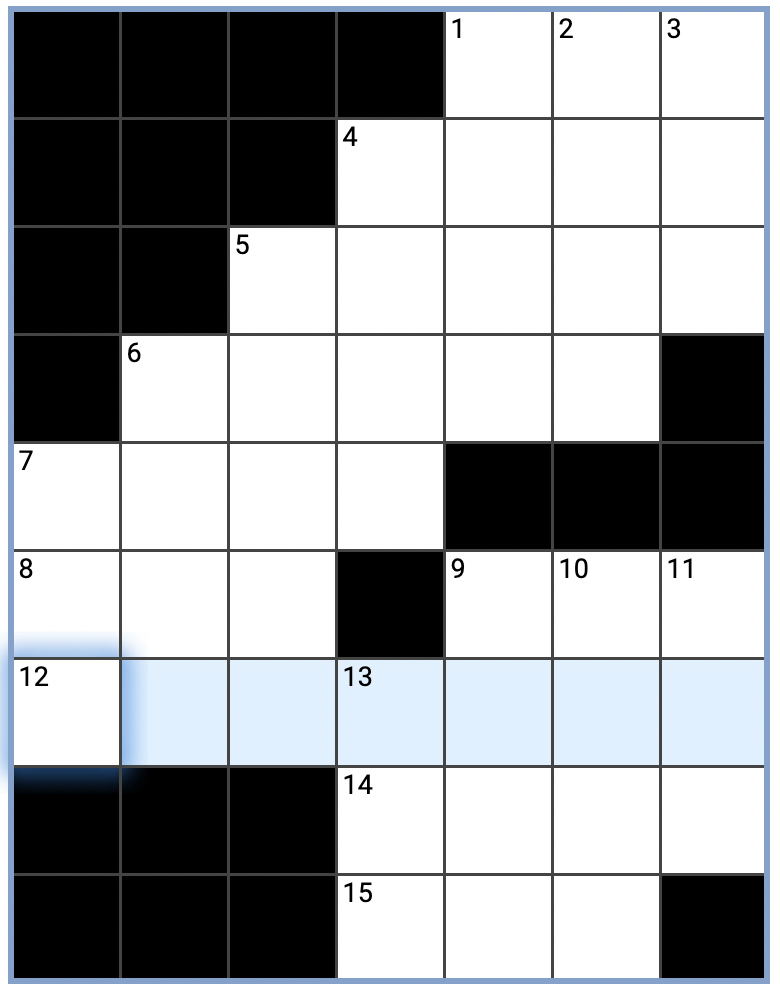
Some things that got axed from prior drafts: HATS/TATS (due to my LEI/LEA mishaps); FAINT/FEINT (due to my self-imposed homophone rule), and WELLS/WALLS (just didn’t work out, and I wasn’t in love with my clue “some stone yard fixtures”). I also ended up changing the grid a lot. I added the square intersecting 7-across/4-down. The bottom-left corner in particular was driving me particularly bonkers. At one point I was even experimenting with a 7×9 grid that extended underneath the HEADS/TAILS.
Finally, I completed a draft I was more happy with. But I knew it wasn’t perfect, and I found myself at a crossroads: where I was in danger of letting the great be the enemy of the good.
This led to some reflection. I knew that the HEADS/TAILS entry, and its crossings, were the “meat” of the puzzle, so to speak. And so I realized that the non-Schrödinger content was much less important. Obviously the other entries needed to fill — they couldn’t be gibberish — but I didn’t think anyone would mind too much if they were on the utilitarian side.
So that’s where I landed with my final grid: On the one hand, there’s some fill that I’m not too proud of — looking at you, my GEO/ESL/OKS corner — but I think it was an acceptable sacrifice to make. After all, the thing I remember about this puzzle is the crossings, and I’d hope that solvers would feel the same way.

Potential for Optimizing? And Other Parting Thoughts.
Ultimately when it comes to the final product, I can’t say I’m not pleased — this is the first Schrödinger that I’ve ever made, and I think it turned out pretty darn well all things considered.
In the aftermath, I’ve been dwelling a lot about Schrödinger puzzles not just as a construction feat, but as a THEME. I think my puzzle does pretty well at justifying the Schrödinger-ness in a fun way — both as a flip of a coin, but also as a mentalism “magic” trick. As a result, I feel like I inadvertently stumbled upon something significant in my puzzle. Both this puzzle and the CLINTON/BOB DOLE puzzle offer a clear choice to the solver, in a Choose-Your-Own-Adventure style where the audience gets to, in a small way, play a role in the crossword’s very construction. In other words, we like making choices, and we like making choices that matter to us.
It’s a personal preference, but that’s as good a reason as any. So even though I want to create more of these (and I probably will!), it’s perhaps not as simple as just picking two related words. Schrödingers will always be fun to create (I’m looking at you, future PASTA/PIZZA puzzle!), but that constructing fun is best when the solver has fun too. And making personal choices (a la CYOA) is REALLY fun.
Then again, I wonder if the reason that I construct crosswords is because I’m so in love with this idea of choice. When you’re making a crossword, every decision – each word, each letter, each black square – has the opportunity to affect the next box, and the next and the next.
I guess what I’m trying to say is: Is a blank grid the ultimate Schrödinger puzzle? Please discuss.
Was there anything about Schrödingers that I missed? Let me know in the comments below! And follow me on Twitter.
2 thoughts on “Making a Schrödinger Puzzle: Part 2”