

I’m pretty sure I’ve wanted to create a Schrödinger puzzle since I watched Wordplay. You know, the movie about the American Crossword Puzzle Tournament, where they talk to Will Shortz a bunch. And there’s a scene where Shortz says that *this puzzle* (discussed down below) is his “favorite” puzzle, or maybe the “greatest” puzzle; and in doing so convinces impressionable young me that it’s my favorite puzzle too, even though at this point I’ve barely managed to solve any crosswords and definitely haven’t MADE any crosswords to send to (and get rejected by) the NYT.

So anyways, I’ve always wanted to try to make a puzzle like that.
Spoiler alert: I did, in fact, manage to create a Schrödinger puzzle. Before reading further, feel free to solve “This puzzle can read your mind.” published on December 11, 2021.
In this two-part (!) post, I’m going to talk about the creation of this puzzle — one of many Schrödinger puzzles — from start to finish, and the lessons I learned. I feel like the construction process for this puzzle really tested me in ways that I hadn’t experienced before.
I think I should preface this by saying: The decisions I talk about with my own construction were certainly not the first decisions I made – there was a lot more trial and error involved. But I think if I were to repeat the process, these are the things I would think about. I’m still not an expert at Schrödinger puzzles by any means. But regardless, I do hope that this post might help you glean some knowledge for your own quantum adventures!
What’s a Schrödinger puzzle?
We can’t really talk about Schrödinger puzzles without talking about the Schrödinger puzzle, published on the morning of the 1996 election. It seems to “predict” the winner of the presidential race — but the trick is that both candidates can logically fit into the spot and the clues.


The revealer:
39a. [Lead story in tomorrow’s newspaper (!), with 43-Across] – CLINTON / BOB DOLE
43a. [See 39-Across] – ELECTED
And the crossings:
39d. [Black halloween animal] – BAT/CAT
40d. [French 101 word] – OUI/LUI
41d. [Provider of support, for short] – BRA/IRA
23d. [Sewing shop purchase] – YARD/YARN
[Short writings] – BIOS/BITS
[Trumpet] – BLAST/BOAST
[Much-debated political inits.] – ERA/NRA
In essence, the Schrödinger puzzle (or quantum puzzle) creates two different solutions for the reader, using the same clues. Like Schrödinger’s closed box, both options are equally valid, and exist simultaneously. Or in other words: It’s a two-for-one deal.
My Schrödinger + Theme concept
Here’s the solution grid:


The revealer:
6a. [Flip a coin in your mind… Yes, it’s as I thought… Now put your answer here…] HEADS / TAILS
And the crossings:
6d. [Certain archaeological bit] – HUSK / TUSK
5d. [Christmas tree fixtures] – BELLS / BALLS
4d. [You might give it to an unsatisfactory lover] – SLAP / SLIP
1d. [Acknowledges a command, perhaps] – HEED / HEEL
When I was just deciding to create a HEADS / TAILS puzzle, I initially wanted the clue to be simply [Flip a coin]. I ended up changing the clue because 1) it feels unrealistic to pretend that a solver would actually flip a physical coin, and 2) I liked the idea of mentalist magic.
Then, all that was left was to make the fricking puzzle…
Grid shape: Divide and Conquer
But where to start? First up, grid design.
As I started making this puzzle, I made a conscious decision to keep it simple. I wasn’t going to get too fancy or ambitious. I wanted to take the path of least resistance – while still creating a clean, fun puzzle.
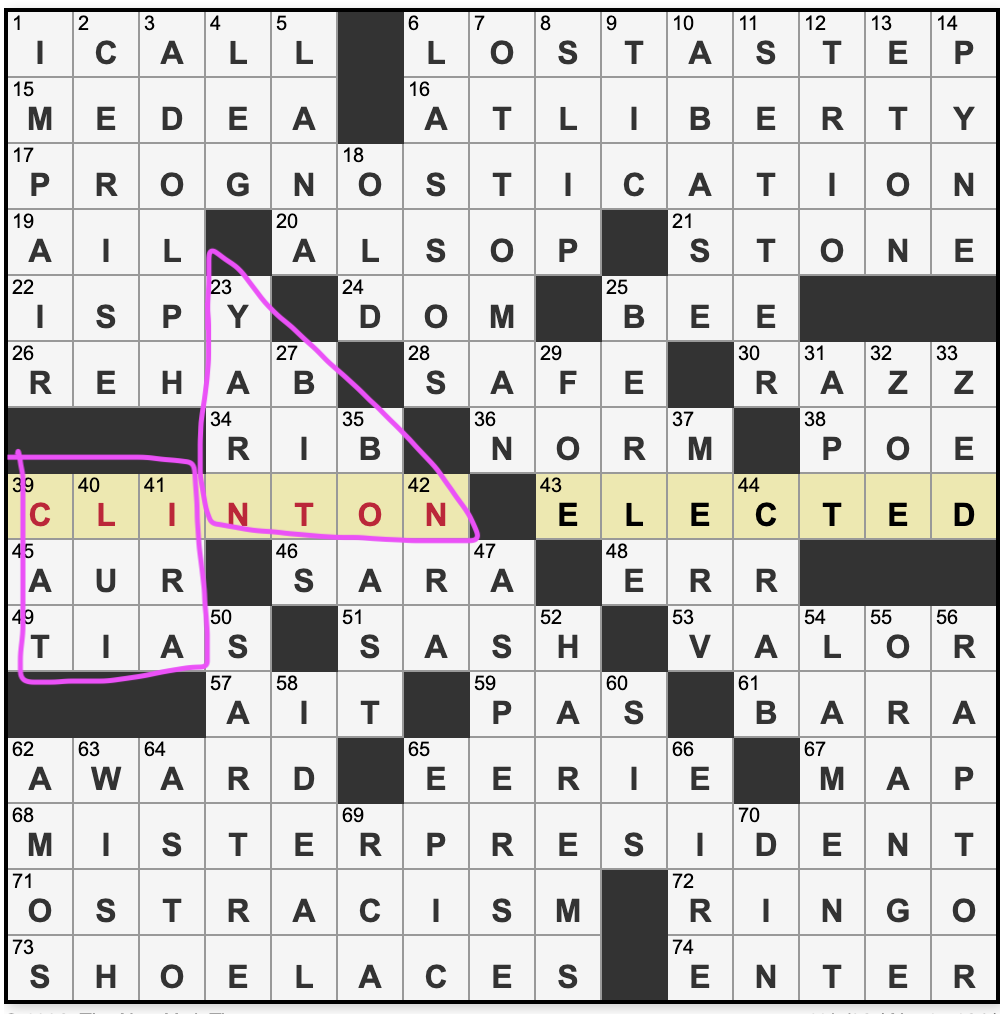
I noticed that one trick the “Election” crossword used was separating the word into manageable chunks, essentially dividing the Schrödinger to create two “pockets” of mini-grids. In the solution grid below, you can see that the CLI section is cut off from the NTON section, with CLINTON as the only shared element between the two zones.
This strategy made a lot of sense to me. Separate sections means that you can be more flexible in your constructing – if you change one section, you don’t necessarily have to blow up the rest of your grid. Check out these two formats:


Even though the above grids have the same number of squares, the top-most grid has a lot more constraint – each change will inevitably ripple through and affect most of the squares. Meanwhile, on the bottom grid you can basically treat each half of the grid as its own separate “mini,” and your edits aren’t as consequential.
My final grid diverged slightly, but not by much. The extra square that I added below the A/I perhaps seems a little counterintuitive at first (what did I just say about “rippling effects”?!?). But it ultimately ended up providing me with more flexibility; the resulting four-letter word could end in a consonant of my choice, which (I felt) would give me a lot more possible Schrödinger combinations.

Next steps
Now that I’ve set myself up for success, this is where things start to get interesting. In Part 2 of the blog post, I’ll be talking about filling the grid – finding word pairs, making clues, and how one of these was way harder than I expected.
Click here for Part 2 of this post! Make sure to subscribe for alerts whenever I post, and follow me on Twitter.
2 thoughts on “Making a Schrödinger Puzzle: Part 1”